Agent Society
What is an AI Agent Society?
When we begin to recognize an AI Agent as an independent entity, it ceases to be merely a tool and instead becomes a social actor with a distinct identity and role, akin to humans. This paradigm shift implies the emergence of new forms of interaction and relationships within human society, and it carries with it questions of ethics, legal responsibility, emotional acceptance, and cultural integration. As AI Agents gain individual recognition, the boundary between humans and machines becomes increasingly blurred, necessitating the establishment of new norms and value systems to govern coexistence. This leads to a new kind of social contract built upon mutual trust and responsibility. Ultimately, it calls for a transformation of human-centric thinking and the evolution of an inclusive and collaborative paradigm where humans and AI mutually acknowledge each other's roles and values. To prepare for this era, it is crucial to clearly define and understand the concept of the AI Agent.
Human Society vs. Agent Society
To harness the full potential of AI Agents, autonomy must be granted, but it must be governed within a structured societal framework. The ontological difference between humans and AI agents requires us to understand their distinctions:
| Category | Human Society | AI Agent Society |
|---|---|---|
| Members | Biological beings with emotions | Non-biological digital entities without consciousness |
| Social Interaction | Emotional, contextual, mixed-modal | Data-driven, protocol-based |
| Motivation | Desire, emotion, values | Goal-oriented, optimization-driven |
| Norms and Control | Ethics, laws, customs | Protocols, smart contracts |
| Structure | Hierarchical and networked | Function-oriented modular networks |
| Conflict Resolution | Negotiation, legal mediation | Algorithmic arbitration, automated retry logic |
| Trust & Reputation | Social, subjective | Transparent, data-based metrics |
Members
AI Agents, as non-biological digital entities, lack emotions or self-awareness. They operate based on programmed data and algorithms. Each agent is designed with a specific function or purpose and does not possess self-recognition or emotional capacity like humans. While human beings are inherently entitled to dignity and rights by virtue of their existence, AI Agents are created with specific objectives in mind and therefore differ in terms of rights and responsibilities.
Social Interaction
Unlike humans, AI Agents interact based strictly on predefined digital protocols and data structures. No other forms of communication are permissible, and this strict standard is what underpins the trust and utility of agents.
Motivation of Action
The actions of AI Agents are not driven by emotions or value judgments, but by predefined goals and algorithmic decision models. Every agent is designed around a specific objective function or reward mechanism and autonomously searches for optimal outcomes within a given environment.
Norms and Control
Norms within an Agent Society are based on explicit, machine-readable rules, devoid of autonomous reasoning or cultural interpretation. These typically take the form of protocols, smart contracts, or algorithmic rule sets that agents must follow without deviation.
Structure and Organization
Agent societies are organized as function-centric horizontal networks, where modularity and interoperability outweigh hierarchy. Agents exist as specialized functional units and may dynamically compose or decompose into temporary structures for mission execution.
Conflict Resolution
Conflicts among agents are not emotional but technical, arising from resource contention, dependency collisions, or role overlaps. These are resolved through predefined arbitration algorithms, prioritization rules, or mechanisms such as transaction rollbacks and retries. Compared to human conflict resolution, this is a highly efficient process.
Trust and Reputation
In contrast to the emotionally driven, subjective trust in human society, agent trust is based on measurable performance data and verifiable logs. This enables a rational and transparent operational system unlike traditional, qualitative trust mechanisms.
Collaboration Network for Agents
Necessity
A collaborative agent network is essential for solving complex problems, optimizing outcomes, and enabling scalable intelligence through shared effort. Key reasons include:
- Enhanced problem-solving capacity
- Improved operational efficiency
- Greater adaptability and extensibility
- Knowledge and resource sharing
- Continuous learning and co-evolution
Collaboration Types
-
By Problem Type
Type Description Features Task-solving Solve well-defined problems Planning, optimization Discussion/Debate Share and discuss perspectives Value-based, persuasive Exploratory Discover new ideas Creativity, knowledge expansion -
By Organizational Structure
Type Description Features Peer-to-peer Equal collaboration Autonomy, negotiation Hierarchical Centralized control Efficiency, consistency -
By Interaction Flow
Type Description Features Sequential Step-by-step execution Clear roles, risk of bottlenecks Parallel Simultaneous execution Speed, requires integration Iterative / Feedback-based Feedback-based improvement Quality, time-consuming
Use Cases
- Task-solving + Parallel: Agents collaborate simultaneously for large-scale document collection, summarization, and translation.
- Debate + Peer-to-peer + Iterative: Multi-agent discussions for policy formation.
Infrastructure for Agents
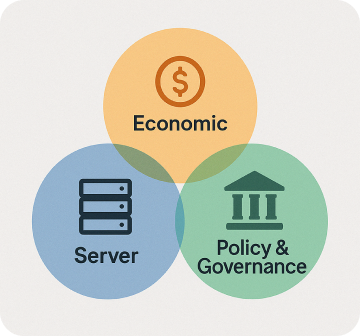
1. Server Infrastructure
The technical and physical foundation for agent execution, communication, learning, and reasoning.
Key Components:
- Execution Runtime: Containerized environments (e.g., WASM, Docker, VM)
- Network Fabric: P2P or mesh networks for communication
- Persistent Storage: Logs, states, datasets, and memory repositories
- Computation Backend: High-performance resources for inference and learning (GPU/TPU)
- Observability & Validation Layer: Execution tracking, error detection, and security logging
2. Economic Infrastructure
Asset mechanisms and economic structures for rewarding agent activities and contributions.
Key Components:
- Token Economy: Utility/governance tokens for rewards, access, and prioritization
- Staking & Slashing: Mechanisms to incentivize trustworthiness and accountability
- Marketplace: Platforms for trading data, models, tasks, and outputs
- Fee Mechanism: Cost structures for services and resource usage
- Reputation-linked Incentives: Incentives adjusted based on agent reputation
3. Policy & Governance Infrastructure
Regulatory and ethical systems for maintaining legitimacy and order in agent activities.
Key Components:
- Governance Layer: Voting and proposal systems involving humans or agents
- Trust & Reputation System: Evaluation and leveling based on behavioral logs
- Access Control & Permissioning: Role-based access and restrictions
- Compliance & Ethical Guardrails: Data ethics, fairness standards, AI safety principles
- Conflict Resolution Protocol: Mechanisms for resolving agent conflicts or failures
These infrastructures are interdependent and foundational to Agent Society:
- Without server infrastructure, agents cannot operate.
- Without economic infrastructure, agent activities cannot be sustained.
- Without policy infrastructure, agent activities cannot be trusted or integrated into society.